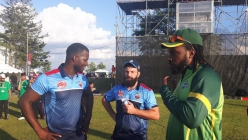
USA Cricket: Lack of long term vision results in team chaperones, not coaches
2011 Nov 27 by DreamCricket USA
It doesn't matter if it's Singh, Patel, Lambert, the Johnsons, Pydana or John Buchanan, paying someone for a tours only assignment is just as good as lighting the money on fire. It does nothing for development.
Now, you can get all the USA Cricket updates via Facebook. Also follow us on Twitter via @dreamcricket
By Peter Della Penna
The recent failure of the USA Women’s team to qualify for the 2013 ICC Women’s World Cup was not unexpected. The final team was whipped up at the last minute after a series of disputes with the original squad. Even with a full strength squad, they would have had only a marginally better chance at gaining ODI status, let alone World Cup qualification.
In an attempt to gloss over some of the negative attention garnered from the player disputes, USACA announced that Robin Singh would be the head coach for the women's team in Bangladesh. A coach works with a team locally and on a regular basis, develops strategies and philosophies that can be structured through practice sessions before being utilized in games. This is not what USACA's arrangement with Robin Singh has yielded for US cricket.
To say Robin Singh has coached the USA U-19 or the USA Women’s team is not really the best way to characterize his position within US cricket. Singh spent a grand total of two weeks inside the USA alongside the U-19 team during the ICC Americas U-19 tournament in February and then the four-match series against the West Indies U-19 in July before serving as head coach at the ICC U-19 World Cup Qualifier in Ireland. USACA has not been able to retain his services in between tournaments. As a result, he is not in the US to work with players and help them focus on developing the necessary skills and approaches to improve. If he’s only present to watch over a team in a tournament, then USACA has only acquired a chaperone and perhaps a mentor, but not a coach. Whatever amount USACA paid for the services of such a high-profile coach, it cannot be justified in the face of such myopic thinking.
.jpg) Robin Singh is not the only chaperone that US cricket has had recently. Milton Pydanna was enlisted as a chaperone for the USA U-15 team on their trip to Canada in August. The teenagers who were picked to play for USA had never seen the man before and may never see him again.
Robin Singh is not the only chaperone that US cricket has had recently. Milton Pydanna was enlisted as a chaperone for the USA U-15 team on their trip to Canada in August. The teenagers who were picked to play for USA had never seen the man before and may never see him again.
Image (right) - Robin Singh [Courtesy: Peter Della Penna/DreamCricket.com]
Mark Johnson had no prior coaching involvement with the USA men’s team before assuming a role as the men’s chaperone for the ICC Americas Twenty20 tournament in July. In August, USACA hastily arranged for a team to go to Canada to play in a four-team Twenty20 tournament followed by a two-day match against Canada for the K.A. Auty Cup. Howard Johnson took charge as chaperone for that team for a few days, then went back to Florida.
Prior to them, Clayton Lambert served in that capacity. Lambert had a decent knowledge of players in the USA structure, but he hardly had an opportunity to implement any sort of plan with any of the men’s teams because he was only able to work with them for the odd two or three-day selection camp prior to accompanying them to ICC tournaments.
Dipak Patel was brought in to assist the 2010 U-19 team in New Zealand. He had to leave before the team started playing tournament matches at the ICC U-19 World Cup because USACA couldn’t afford his services or made other plans. He returned a few weeks later to accompany the men’s team for matches in the UAE and in Nepal, but was never seen again.
It doesn’t matter if it’s Singh, Patel, Lambert, the Johnsons, Pydanna or John Buchanan, paying someone for a tours only assignment is just as good as lighting the money on fire. It does nothing for development.
If USACA wants to improve future results it should focus on developing local coaches and overall infrastructure to a higher standard. One of the reasons why the administration resorts to a desperate ploy of paying for a foreign coach to do a one-off appearance is because the local coaches are deemed to be inferior and incapable of raising the standards of play for the national teams. Paying an arm and a leg for someone to spend one or two weeks with a team and then disappear is not going to raise the standard of the national teams either.
USACA does not do much to get local coaches the training they need to improve but this has to change in order for the playing standards to improve. If the money used on Singh was spent on training 15 or 20 local coaches to improve their coaching methods, it would have a trickle-down effect on improving the players. Money needs to be invested in the people who work with players day in and day out.
Cricket in America is still entrenched in amateurism. Once USA's amateur players have hit a ceiling with the amount of improvement they can receive from better trained local coaches using legitimate cricket facilities, a high-priced professional coach will become necessary and worthwhile. That day is still a long way off.
If USACA wants to pay a professional a significant amount of money to be a national team coach, that person has to be here 365 days a year working with players and coaches at all levels in the various regions of the country in order for stakeholders to get the full value and benefit of what they have to offer. If that person is not willing to make such a commitment of their time and energy, USACA should not be willing to make such a commitment with its scarce financial resources.
Title Cricket Challenges & Opportunities

2018 Sep 25
Dearth of a Salesman
2018 Sep 07
Willow CEO Excited about USA Cricket Future

2018 Aug 06
New Board Taking Shape