USA Cricket News
USA Cricket: 2023 World Cup Qualifier Tour Report Card Part 1 – Team Grades
2023 Jul 10 by DreamCricket USA
By Peter Della Penna (Twitter @PeterDellaPenna)The first part of the tour review for the USA Men's ODI squad's winless showing at the 2023 ICC World Cup Qualifier in Zimbabwe focuses on each of the collective disciplines from a team aspect.
Batting: F
At a tournament where high totals were the norm, and batting second was conducive to chasing down targets in order to produce some historic results achieved by numerous teams, USA failed. USA had a 50/50 split of batting first and batting second across their six matches. It didn’t matter if conditions were in their favor or against them, both their technical and their tactical approaches with the bat always wound up falling short.
A very telling comment was made during the post-match presentation for USA’s first loss of group play against the West Indies when opposition captain Shai Hope made pointedly backhanded compliments after being asked about the century scored by USA’s Gajanand Singh, more or less saying he was not really impressed because the USA player did not really try to push for victory at a time when the door had been left ajar by West Indies for USA to get across the line. The final margin may show that USA lost by 39 runs chasing a target of 298, but the reality is that USA could have won that match with a bit more impetus shown during the middle overs in particular.
So it was no surprise that USA fell short against UAE on the final day by one run chasing a target of 309. Much of the attention regarding that failure came down to the final over when USA lost two wickets off the final three balls when they needed just four runs to win. However, the match should never have come down to the final over. Once again, an overly conservative batting approach in the middle overs came back to bite them, in particular the running between the wickets which was frequently criticized on air by the ICC commentators for being lethargic and at times just outright lazy. Easy singles were turned down, but far more frequently there were a series of what should have been comfortable twos stroked wide of boundary fielders that instead wound up being very long singles with no pressure put on a relay throw back to the middle.
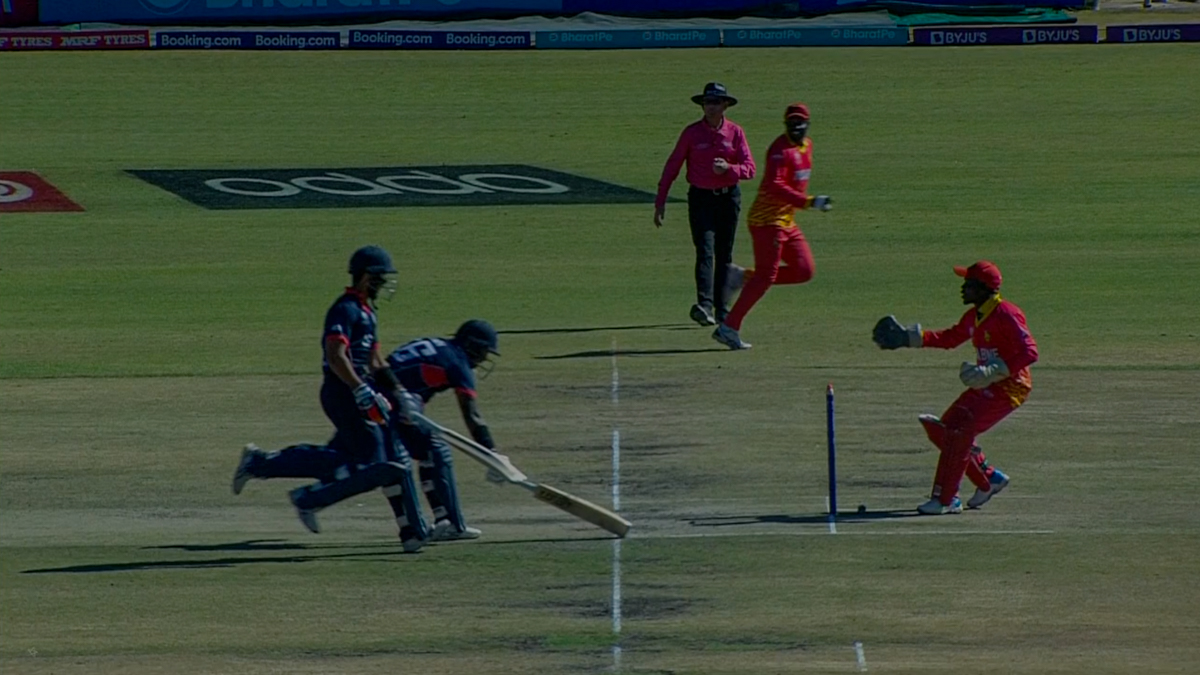
USA’s shockingly poor running between the wickets reached its nadir during the loss to Zimbabwe when three players were run out, all of them in a manner that sparked widespread mockery among people watching USA for the first time. The USA Women’s U19 team experienced similar problems at the 2023 ICC Women’s U19 World Cup in South Africa and finished as the team with the most runouts in group play. It once again reinforces the notion that there are systemic issues with regards to infrastructure and player development around the USA in which players are not able to adapt quickly to international standard outfields and the fielders that are produced by opposition teams in such conditions.
USA’s players are used to playing on poor outfields where the ball travels differently than it does in international play. The standard of fielding in US domestic cricket is also very poor in the sense that it is not often a player comes up against elite fielding sides, regardless of the field conditions. As a result, players develop bad habits in local cricket when it comes to running between the wickets and this is demonstrated in plain sight when the TV cameras are rolling.
In terms of sheer scoring, USA did not have anyone finish in the top 15 in runs. The best was Gajanand Singh, who finished with 252 runs in 17th place in the event and not far behind him was Shayan Jahangir with 242 runs. Only two other players crossed 100 runs in the event for USA, and their third highest average in the tournament was Nosthush Kenjige, who batted at No. 9 for four of the six matches. Only two players besides Jahangir and Gajanand even crossed 100 runs for the tournament for USA (Modani and Jones). Some people may want to excuse this on the illness bug that ran through most of the squad and meant most players missed at least one match. Whatever the excuse is, the raw data is grim.
In case it wasn’t obvious from the fact that Gajanand and Jahangir were USA’s two highest scorers on tour, the top order contributions were massively disappointing. Eleven out of 18 individual scores made by the top three in the lineup did not pass 10, and there were just two half-centuries from the same positions across the tournament for USA. The average opening stand for USA was 18 runs, and two of the opening partnerships ended before either opener had scored a run off the bat.
Partnership wise, there were 29 century stands across the tournament, and just one of those was made by USA as it came in the final match between Monank and Jones for the third wicket. By contrast, Netherlands, who qualified for the World Cup as an Associate out of the same group as USA, had four century stands. There were only five half-century stands for USA as well. Three of those came thanks to the sixth, seventh and eighth wicket stands due to lower order players such as Jessy Singh and Nosthush Kenjige pulling their weight after the top order had not.
Bowling: D
As bad as USA’s collective batting was, the bowling did little to cover up for the deficiencies on the other side of the ball. USA looked especially toothless for the large portions of the tournament when Ali Khan was either suspended or missing due to illness. USA’s leading wicket-taker was Kenjige with seven wickets. That made him tied for 24th overall in the tournament. USA only took 33 out of a possible 60 wickets overall across six games. This looks even worse when considering that they bowled out the West Indies in their opening match, meaning they took an average of 4.6 wickets across each match for the rest of the tournament.
USA’s fielders did not help matters as there was little to no pressure applied in the field (USA completed zero runouts in the field in the tournament) and the typically high number of chances were put down by USA in the field, often at crucial times. That was especially the case in the West Indies match when Jason Holder was dropped multiple times before going on to make a match-winning half-century.
As reflected by the wickets column, Kenjige was generally USA’s best spinner on tour while a case can be made that Saurabh Netravalkar was USA’s best bowler overall on tour, taking six wickets at an average of 33.33 and an economy of 4.34 across 46 overs. Aside from Kenjige’s respectable 4.89 economy across a team-high 56 overs, nobody else on the team had an economy rate below six per over. Kenjige also highlighted his value in the field by taking a team high five catches, including two brilliant catches off his own bowling – one against Ireland and another against UAE.
But there was little help elsewhere. Though Wanindu Hasaranga and Maheesh Theekshana finished as the two highest wicket-takers in the tournament (Theekshana had six more than the third best bowler), the event was more dominated by pace bowling in the wickets column as early morning conditions favored seamers after winning the toss and choosing to field first. USA was an anomaly though. Nine pace bowlers took double-digit wickets at the tournament, but USA’s best managed just six. There is a severe drop-off after Ali Khan and Netravalkar in USA’s pace bowling stocks, and the fact that Kyle Phillip was banned from bowling after two matches also severely affected matters for USA.
Part of USA’s issue though was tied to selection, which will be touched on later. The spin unit was comprised of finger spinners only. The bowlers who did the most damage in the tournament – Hasaranga and Chris Greaves – are wristspinners. USA’s refusal to pick and develop a legspinner following the phasing out of Timil Patel set them up for failure at an event like this.
Fielding: F
USA’s fielding was routinely the butt of jokes from the ICC on-air commentators, which underscores how bad it was considering the official host broadcasters typically lean towards having a glass three-quarters-full view of watching teams.
When USA wasn’t dropping chances, they were fumbling regular collections in the ring to allow quick singles. Or alternatively, they were diving over the top of balls on the boundary to turn a single or a two into four.
USA’s average age in the touring squad was 30.13. Sai Mukkamalla is the youngest player in the squad at age 19. But barring the two times each that Kyle Phillip (26) and Abhishek Paradkar (22) played, USA’s next youngest player on the field was usually Shayan Jahangir and Aaron Jones, both 28. Everyone else in the squad is 30 or older. It showed more than anywhere else in the field. USA looked old and slow. They were often a step slow, couldn’t collect cleanly, could not throw accurately. As was stated earlier, USA did not complete a single runout in the field.
USA had at least 10 missed chances in the field. On the flip side, USA’s opponents may have given away more runs in the field with their missed chances as Gajanand Singh was missed on 0 in the slips against the West Indies during his century, while Shayan Jahangir was dropped three times (on 4 on the first drop) on the way to making 71 against the Netherlands. But the reality is that USA’s opponents were vastly superior in their batting and bowling to cover up for any fielding deficiencies. USA on the other hand had no margin for error if they wanted to win and their drops became far more costly as a result. The drops of Jason Holder on 24 before making a 34-ball half-century, and also Paul Stirling at second slip on 7 on his way to a 35-ball half-century for Ireland in their brisk chase of USA’s 196, were particularly damaging.
Selection/Tactics: F
More of this will be discussed in the final section of the tour review (outlook for the future/2024-2027 Cricket World Cup League Two cycle), but USA’s stubborn refusal to develop younger players and in particular a legspinner finally came back to bite them in a big way in this event and showed how far behind they are compared to the other competing teams. Yasir Mohammad was given three matches in the summer of 2022, and given little encouragement on field by team leadership within those matches, before USA selectors pulled the plug on him. Other legspin options, such as Raymond Ramrattan, were never tried. USA adopted a very conservative philosophy when it came to their team selection as well as their on field tactical approach on both sides of the ball. As a result, their on-field product in Zimbabwe looked bland, uninspiring and outdated compared to other teams at the tournament.
As was noted before, Only three players in the squad were under the age of 28. Across the entirety of the 2019-2023 Cricket World Cup League Two cycle, USA used 27 players, second most behind Nepal’s 32. Nepal struggled badly until the final 12 matches when they came to settle on a combination that saw them run off 11 straight victories to vault into third place and an automatic berth in the World Cup Qualifier.
USA’s overall squad instability hurt them badly. But the most puzzling part was the near instant discarding of young and locally developed talent while other players seemed to get a much longer leash.
Rahul Jariwala, Sanjay Krishnamurthi and Yasir Mohammad were given four, three and three matches respectively before being cast into the wilderness. Krishnamurthi at least has latched on with an MLC franchise (San Francisco Unicorns), but Jariwala and Mohammad appear to be way off the USA radar at the moment. Not included in this are Vatsal Vaghela and Ritwik Behera, who debuted in the T20Is against Ireland in December 2021 but have been cast aside fairly quickly. Ali Sheikh, who was included in the USA squad for that series, still hasn’t taken the field for USA at senior level in spite of the fact that MLC talent scouts couldn’t get enough of him, leading to his selection in the sixth round by LA Knight Riders. When a player like Ali Sheikh in particular is available, someone who is a threat with bat, ball and with his fielding, it makes some of the other player selections taken to Zimbabwe all the more head-scratching.
The faith shown by selectors in Shayan Jahangir after two underwhelming tours of Namibia prior to the Qualifier in Zimbabwe was justified after he finished second on the tour in runs. Sai Mukkamalla also showed glimpses of what he is capable of by following up his match-winning century against Namibia in April with a 41-ball half-century against Ireland before he was terribly unlucky to be runout when a drive by Sushant Modani was flicked onto the stumps by Andy McBrine reaching his fingers out in his follow-through. Why is a similar level of faith not shown more regularly in the younger, locally developed talents, especially when such a long leash is given to other players who continue to underperform for USA?
Within the tournament itself, USA’s tactics cost them potential wins against West Indies and UAE in particular. USA does not seem to have a grasp of whether or not to go hard in the Powerplay or graft the new ball away and bide their time to score later. They wind up doing neither. The consistent failure though is in the middle overs against spin when they do an especially poor job of rotating the strike and are generally risk averse to taking tight singles or turning ones into twos. Their general risk averse attitude when running between the wickets makes the number of runouts that USA achieved in the tournament all the more baffling. USA threw away numerous winning positions, especially with the bat, and most of their failures were seemingly down to having muddled mindsets, unsure and lacking confidence in the way to go about approaching the innings as a team.
The alignment of certain aspects of the lower order also significantly hurt the team in close matches. Nosthush Kenjige finishing the tour with the third highest average on the team highlighted the fact that he often batted too low at No. 9. He was promoted to No. 5 in match two against Nepal, which was an overcorrection after his 34 not out off 32 balls against the West Indies in match one. But then shipping him straight back to No. 9 solved nothing. Abhishek Paradkar also showed promise in his first innings against Zimbabwe, but then failed when promoted to No. 6 against Ireland on a day when USA was missing several first-choice batting options and was playing with a lengthy tail, and he promptly got out third ball. Team management's stubborn refusal to take Nisarg Patel out of the No. 7/8 position throughout the tournament did nothing to help the team either.
Specifically, captain Monank Patel said in his post-match interview comments that he thought USA “panicked” against UAE towards the end. He used the exact same word to describe the final sequence of the infamous tied match against Nepal in Texas in the summer of 2022. More than anything, that shows that USA’s players don’t really adjust or adapt after experiencing similar scenarios compared to say the Netherlands, who stumbled on numerous occasions in the ODI Super League but learned their lessons to the extent that they came out victorious when encountering similar situations in the Qualifier. USA on the flip side, did not seem to have ever absorbed any key lessons over the course of playing 36 ODIs in Cricket World Cup League Two. If anything, they have stagnated or in some ways have gone backwards as a team based on their showing in Zimbabwe.
Fitness: D
The team was clearly affected by the illness bug which took nearly everyone off the field at some point during the tournament. Only Modani, Kenjige and Gajanand Singh played all six matches. Coincidentally, Kenjige and Modani are consistently seen as 1A and 1B as team leaders when it comes to fitness testing results. Gajanand, in spite of not having the same level of fitness as the other two, was fit enough to be able to stay at the crease and finish as the highest scorer on tour. Netravalkar as well looked like he shed 15-20 pounds before this tour and showed up to Zimbabwe as fit as he has ever been in his USA career which began in 2018.
Whether by coincidence or not, players who in the past have typically struggled to maintain their fitness for USA were the ones who at one point or another fell victim to the illness bug on tour. Make of that what you will. But on the whole, USA’s poor fitness is reflected in their inability to stay for long at the crease as well as their collectively poor fielding. In a country of 350 million, it should not be so hard to find eleven skilled and physically fit players. But USA Cricket makes it seem like a herculean task.
[Views expressed in this article are those of the author. If you have different views or opinions, we respect those views and urge you to provide your feedback, both positive and negative. Feel free to respond to the author via Twitter @PeterDellaPenna.]
Recent USA Cricket Stories