USA Cricket News
USA Cricket: 2023 World Cup Qualifier Tour Report Card Part 2 – Player Grades
2023 Jul 11 by DreamCricket USA
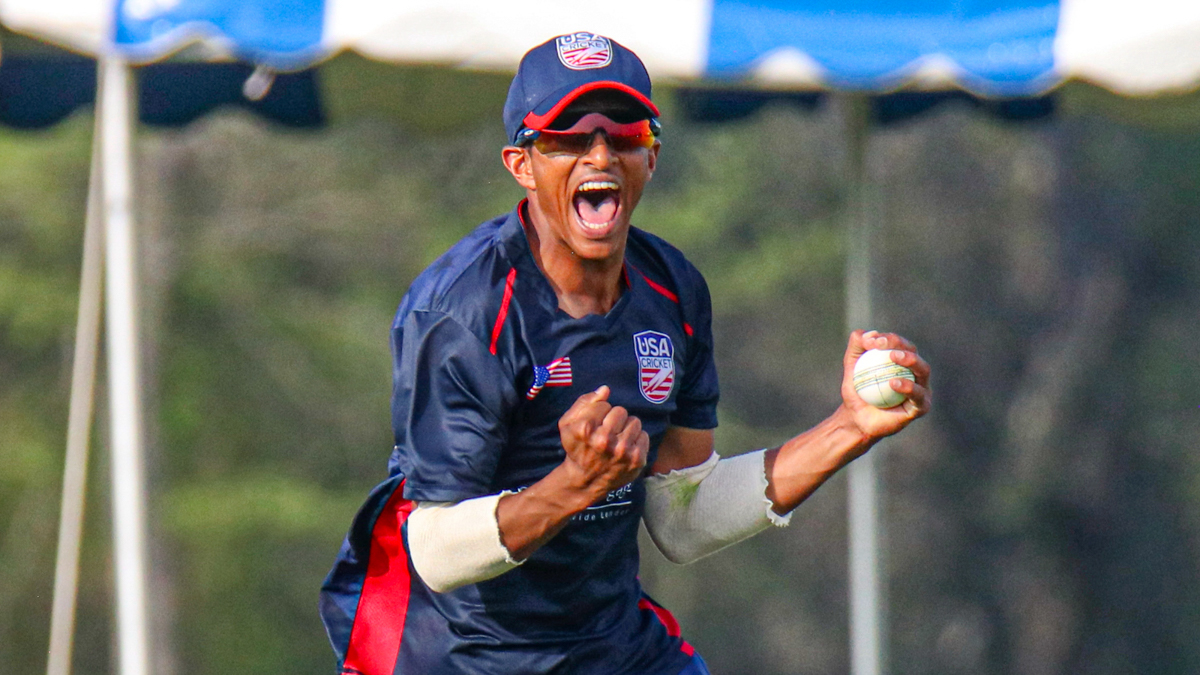
By Peter Della Penna (Twitter @PeterDellaPenna)The second part of USA's tour report card from the winless tour of Zimbabwe for the 2023 ICC Cricket World Cup Qualifier focuses on individual evaluations for all 15 players in USA's touring squad.
File photo credit: Peter Della Penna
For those unfamiliar with how individual players have been graded in the past as part of DreamCricket’s post-tournament report cards, each player is evaluated with regards to their specific role in the team on a match-by-match basis and not solely based on aggregate stats.
Players who excel under pressure and against higher quality opposition are graded more favorably. Overall chances given by a batsman, as well as overall chances created by a bowler, are taken into consideration regardless of total runs scored or wickets taken. Bonus marks are given for good fielding while a player can also be downgraded for weak fielding including dropped chances. Players must also play in a minimum of 50% of the matches on tour to receive a grade.
With those guidelines laid out, here are DreamCricket’s player grades for the 2023 ICC World Cup Qualifier in Zimbabwe.
Steven Taylor – F
Not for the first time, Taylor has done less with more opportunities, including the premium ones opening the batting. He finished the tournament with 55 runs in five innings at an average of 11.00 and a best of 23. His average ranked 11th for the team in the tournament. He was rested for the final match against the UAE.
Taylor’s main redeeming quality on tour, as has often been the case in recent years, was his bowling. He took 3 for 53 in the opening match against the West Indies in a spell that shifted momentum heavily back toward USA in the field before sloppy fielding undid much of his efforts. However, he bowled just 24 overs in the rest of the tournament, taking just one wicket for 142 runs. Whether he was underbowled or taken out of the attack due to ineffectiveness depends on your perspective.
In the field, he dropped two chances. Neither chance was particularly easy, one was a skier running back from slip against the West Indies and the other was a diving slip chance against Nepal. But neither was held. He claimed one catch in the tournament.
For someone with great expectations and a level of talent unmatched in the USA squad, Taylor wildly underperformed.
Sushant Modani – D
USA’s other established opener finished third on the team in runs at the tournament with 126 runs at an average of 21 and a best of 55 off 93 balls against Ireland. He had one other decent score against Nepal where he made 42 as he watched wickets tumble at an alarming rate opposite him during Karan KC’s devastating new-ball spell before he was eventually the sixth player dismissed.
The issue with Modani is that his runs are rarely impactful. More problematic is that he offers little value in the field. He took no catches during the tournament, is often hidden in lower traffic areas and when the ball does come his way, he is prone to misfields.
Modani did not necessarily harm USA with his performance, but he added little. In spite of his top level fitness and work ethic, his output is minimal. At age 34, deep consideration needs to be given as to whether he should be part of USA’s plans for the next four-year World Cup cycle.
Monank Patel – F
The USA captain scored just 15 runs in the group stage, missed two of the four group matches due to illness, and then made 61 in the last place match against UAE before getting out playing a shot which was a product of dot ball pressure placed on him at the opposite end by his batting partner Jones. Monank’s average of 19.00 placed him seventh on the team in the tournament.
Monank’s use of bowlers was a bigger issue. Taylor was arguably USA’s best bowler against West Indies, but did not bowl a full quota while two overs were wasted with Aaron Jones. Against Zimbabwe, in perfect early morning new ball seam bowling conditions at a time when Abhishek Paradkar was beating the outside edge regularly in his opening spell, Nosthush Kenjige was used as a new ball spinner instead of giving Jessy Singh the new ball with Paradkar. Later in the innings, Usman Rafiq, chosen as a specialist spinner, was given only four overs while Nisarg Patel, so often used as a 10-over spinner by Monank, was shielded by the captain and four extra overs given to Gajanand Singh’s part-time spin instead. Ali Khan, USA’s best strike bowler, was never brought back for a second spell against Ireland. Rafiq, again picked as a specialist spinner in that match, bowled just 1.2 overs in a game which shouted “throwing in the towel” in the field.
Behind the stumps, Monank took two catches and had one stumping. Like Taylor, a lot was expected from someone of his talent and capabilities but he underdelivered.
Aaron Jones – F
According to the raw stats, Jones made 116 runs in five matches at an average of 23.20, numbers which placed him fourth and fifth on the team respectively on tour. Scratch a bit deeper behind the numbers and they’ll show that Jones scored 41 runs in four innings during group play, including a best of 23 against the West Indies, before top-scoring with 75 off 103 balls in the finale against UAE.
But anyone watching the tournament saw someone who was involved in numerous runouts – he was dismissed that way twice – and despite being USA’s fastest runner between the wickets (when he actually decides to run hard), he is also arguably their worst runner between the wickets. The century partnership with Monank in the loss to the UAE highlighted this even more than his runouts against West Indies and Zimbabwe because he was regularly turning down singles or jogging for ones while Monank was running hard trying to push for twos. He cost USA a handful of runs in this partnership alone due to poor running between the wickets in a match that was ultimately decided by one run.
This does not even touch on his extremely conservative approach at times in which the majority of his dots are balls defended. There were also multiple times deep into his innings in which he opted to shoulder arms and leave balls alone. His approach is not someone looking to attack the opposition and force them into mistakes, but rather a player who is patient to a fault, waiting and hoping for a mistake to come that he can capitalize on. Such a strategy is effective against weaker teams where mistakes do come from the bowler. But against top class opponents like USA faced in this tournament, he struggles to find a scoring option B and it results in an incredible amount of pressure shifted back onto his batting partners.
In the field, Jones offers very little. He had a drop against the West Indies and took one catch. In general, he is a weak fielder who remains mostly anonymous. With the ball, he bowled two overs against West Indies, conceding 0 for 13. It means his string of being wicketless in List A cricket since 2018 continues.
Jones started off his USA career in 2018 as one of the squad's key scorers. But his role going forward is a matter for discussion because more often than not, he kills the team's momentum the longer he stays at the crease.
Sai Mukkamalla – D
The 19-year-old had a horror start to the tournament, carding back to back ducks against West Indies and Nepal. He made 10 against Netherlands before scoring a 41-ball half-century against Ireland and looked set for something far bigger before he was runout for 55 at the non-striker’s end on a drive that was deflected off the bowler’s hand into the stumps. In the finale, Mukkamalla made 21 against UAE.
Mukkamalla at times has a tendency to be too aggressive, as was evidenced by his dismissal against Netherlands when he was bowled through the gate trying to repeat a successful drive against the moving ball from one delivery earlier. Against UAE, he was in the midst of a sequence where he was pummeling boundaries until he went for one too many, gifting an edge behind on a short and wide ball outside off. Seeing how timid most of his teammates are though, it’s hard to fault Mukkamalla for showing aggression in a team where it is sorely lacking. His strike rate of 108.86 was the best in the squad, again underscoring his keenness to play shots, score runs and turn over the strike in spite of the fact that he is not a menacing physical presence in the same manner as some other players in the USA lineup.
In the field, Mukkamalla took no catches. He brings a lot of energy, but is still adapting to international standards because at times he is guilty of taking poor angles to the ball in the field that lead to extra runs. However, that is something that is fixable far more so than the lethargy seen elsewhere among the squad.
Gajanand Singh – C-
USA’s leading scorer on tour with 252 runs at an average of 50.40 with one century against West Indies and another fifty in the finale against UAE. However, as elsewhere, the raw numbers only tell part of the story.
Gajanand’s 101 not out off 109 balls against the West Indies involved a very late push in the final three overs after the match had already been lost, and also came after a go-slow period in the middle overs when he struggled mightily to rotate the strike against the left-arm spin of Akeal Hosein. It was at a period of the match where USA still had a genuine chance to win but all momentum was lost, and he was also responsible for the runout of Aaron Jones in the early part of that sequence battling against Hosein.
Gajanand got starts against Nepal and Netherlands, the latter a situation where he was slightly unlucky to be caught gloving a pull down the leg side to Vikramjit Singh’s part-time medium pace for 33. He scored 13 against Zimbabwe, but it was an innings that masked his involvement in two more runouts – Aaron Jones for 8 and then Shayan Jahangir two balls later in a scene which went viral in the cricket community for the desperation of Gajanand to make his ground ahead of Jahangir when both were in the process of winding up at the striker’s end.
His only real failure came against Ireland, where he was out for 10 off 9 balls chipping a soft return catch to Andy McBrine’s offspin. His best knock came against UAE, where he 69 off 44 balls and covered up for Jones’ slow knock but ultimately got out at a crucial time which resulted in USA being unable to get across the line.
In the field, Gajanand’s fitness causes issues as he regularly dives over balls and leaks extra runs by turning ones or twos into fours. He had a crucial drop against Ireland, dropping Paul Stirling in the slips on 7 before the Irish opener belted a 35-ball half-century.
Gajanand has turned into one of USA’s most valuable batters in the last 18 months. But his running between the wickets is an issue, as is his sloppy fielding, and both cost USA at times during the tournament.
Shayan Jahangir – B-
One of the few silver linings of the tournament for USA was the emergence of the 28-year-old Jahangir. After entering the World Cup Qualifier with 96 runs in seven innings, he scored more than twice that amount in Zimbabwe alone, ending as USA’s second highest scorer with 242 runs including a century against Nepal and a half-century against the Netherlands. His strike rate of 103.86 was second best on the team while his average of 60.50 was tops in the squad. That average may have been much better and he could potentially have finished as the leading scorer on tour had he not been runout without facing a ball in the match against Zimbabwe.
Jahangir started off the tournament with what was then a career-best 39 off 49 balls against West Indies, but got out at a time where USA conceivably could have pushed for victory had he stayed out even for just another five overs rather than getting out at the end of the 34th. Seemingly determined to right the wrong of the way that innings ended, he came out and made a 79-ball unbeaten century against Nepal, spending large portions of his innings shepherding USA’s lower order after Karan KC had ripped apart USA with the new ball. It may not have made a difference in the end, considering Nepal chased the target of 208 with seven overs to spare, but there was a slight bit of immaturity in his obsession with making a maiden century to the extent that taking the single to bring up three figures put the tail on strike and Jahangir never got back on strike as a result after Gulshan Jha wiped out Saurabh Netravalkar and Kyle Phillip in the space of three balls to end the innings with an over left unused.
Jahangir top-scored with 71 off 86 balls against the Netherlands, in spite of being dropped three times (including the first time on 4), but got out at a crucial time to start the 46th over. Had he stayed to the end, USA might have ended on 230 or more instead of 211 and could have put a bit more pressure on in the field to push for an upset. After missing the Ireland match, he returned to make 32 off 19 balls in the chase against UAE but once again got out at a pivotal time, unable to close out the innings and the match for USA after pulling a slower ball to deep midwicket. Jahangir had already won the over with two boundaries to begin the 47th, but poor match awareness cost him his wicket when he tried to bash another boundary in a situation where a single would have been sufficient.
In the field, Jahangir tied for a team-best five catches, mixing performances behind the stumps in the two matches where Monank was out ill with three matches playing as an outfielder. When he didn’t have the gloves on, fielding was at times an adventure. He at times misjudged balls quite badly, but was athletic enough to compensate for it at times, in particular one leaping catch in the deep after he had nearly overran the ball coming in too far off the rope.
On the whole, Jahangir has established himself as a key player to build around going forward for USA.
Nisarg Patel – F
It’s hard to know where to put the blame here because Nisarg doesn’t pick himself. But the extraordinary blind faith that USA selectors, coaches and captains have placed in him has rarely been justified with on-field performances, especially against quality competition. Nisarg’s defenders may point to the Cricket World Cup Qualifier Playoff in April, where he was second on the team with 11 wickets. But those performances came against noticeably inferior competition compared to what was in Zimbabwe.
Nisarg generally puts in a decent effort and many coaches and fans have pulled for him to succeed considering he is a product of USA’s U19 system having played for the country at the 2006 ICC U19 World Cup. But the reality is that he has had an extraordinary amount of chances for USA and rarely if ever delivers, especially against good opponents or when it matters.
Perhaps no moment summed up Nisarg’s batting career for USA more than the final moments of the chase against UAE. After hitting a boundary to bring the winning equation down to four off three balls, he was bowled by a slower ball for 14 and USA fell short by one run. The match did not have much riding on it pressure-wise considering it was a last place consolation playoff. It is not as if USA was playing to retain or gain ODI status, let alone a spot in the World Cup. But even in these circumstances, Nisarg could not deliver. It followed up batting sequences throughout the tournament where he came in with an opportunity to shape the match in USA’s favor but failed to do so: 8 off 25 v Nepal, 1 off 12 v Netherlands, 2 off 10 against Zimbabwe, and 6 off 13 against Ireland. Each dismissal wound up being tamer than the previous one, and the score against Nepal also included being dropped on a simple chance on 3.
In all, Nisarg ended with 31 runs (off 70 deliveries) in five innings at an average of 6.20 and a strike rate under 50. This happened while batting at No. 7 or 8 in every match. It’s a position where significant match-winning scoring production is expected as a finisher, and/or an ability to adapt and stretch the innings out if the player in this role enters fairly early after a cluster of wickets. Nisarg showed no capability of either being a finisher or a match-stretcher.
With the ball, Nisarg was equally underwhelming: 2 wickets for 193 runs in 31.2 overs. His figures would have been far worse had he not been shielded by his captain against Zimbabwe when he was pulled out of the attack after three overs, the last of which was a demolition at the hands of Sean Williams. In a match where USA conceded a record total of 408 for 6, he was nowhere to be found. In the prior match against the Netherlands, he released all the pressure that Jessy Singh had built up during Jessy’s double-wicket burst which reduced the Dutch to 83 for 4 as Scott Edwards toyed with him in a spell that ended with figures of 0 for 60 in 8.2 overs.
In the field, Nisarg can and will take straightforward chances – he took two catches – but is weak along the ground and not someone expected to hold onto more difficult chances. In a country blessed with no shortage of quality left-arm spinning options who are brilliant fielders, Nisarg is by far the weakest fielder of them all, further calling into question his selection. At 35 years old, he is the second oldest player in the squad and it is hard to envision him being a part of the squad for the 2027 World Cup cycle if he is going to be 39 by the end of it.
Jessy Singh – D
The 30-year-old’s career arc is almost eerily similar to that of Nisarg, the main difference being that Jessy is a pace bowler. A homegrown player who was a product of the USA junior system, Jessy has worked hard to make the most out of his abilities. But this tournament once again showed that while Jessy is an excellent domestic standard player, he does not have the top-level talent that matches his strong work ethic in order to be able to compete against teams at the standard seen in the Qualifier.
Perhaps the biggest minus against Jessy though is that over a career with USA that goes back to his debut in 2015, he has never really corrected his no ball issues. This reared its head in a significant way in the final match against UAE, when Asif Khan belted a no ball for six before capitalizing on a free hit for another six in the final overs of the first innings.
After 0 for 76 against West Indies (a match in which he had two chances dropped off his bowling), he returned a very respectable 0 for 38 against Nepal before another gritty performance claiming 2 for 35 in eight overs against the Netherlands. Against Zimbabwe, he returned the most expensive figures in USA’s ODI history, 2 for 97 in 10 overs, which was not entirely fair on him considering the way that he was served up by his captain like a lamb to the wolves while other bowlers were protected. After sitting out against Ireland, he came back for the last match against UAE where he returned figures of 0 for 88 which included not just one but three costly no balls.
At bat, Jessy provided a bit of spine in USA’s lower order, making 38 off 53 against the Netherlands as part of a half-century stand with Shayan Jahangir. He also made 21 off 26 against Zimbabwe, which was good enough to be USA’s second highest score on the day.
But in matches where the pressure is on and USA finds themselves in a winning position, Jessy emulates Nisarg in seemingly always falling short. He made 6 off 17 against West Indies, 12 off 25 balls against Nepal, and then with the match in his hands to win, scratched out 7 off 13 balls against UAE before being caught off a slower ball pulling to deep midwicket.
In the field, Jessy took one catch and was one of USA’s better ground fielders. He is generally above average, but not great, which in a way sums up the other facets of his game.
Nosthush Kenjige – B-
Consistently the player with the best work ethic in the squad, Kenjige bore the fruits of that with a very respectable tour in all three facets of the game.
With the ball, the left-arm spinner bowled the most overs for USA and ended as their leading wicket-taker, claiming seven scalps at an average of 39.14 and an economy rate of 4.89 across 56 overs. Kenjige bowled at every stage of the match during the tournament and took at least one wicket in every match. He began with an impressively disciplined 1 for 44 in 10 overs against the West Indies, and had 1 for 37 in nine overs against Nepal before turning in arguably his most impressive match of the tour finishing with 1 for 31 in 10 overs against the Dutch. Even against Zimbabwe on a day when USA’s bowlers conceded a record total, Kenjige was the most economical bowler on the day ending with 1 for 62 in 10 overs, figures which also included dropped chances off of his bowling. He ended the tournament with 2 for 41 in seven overs against Ireland and 1 for 59 in a full 10 against the UAE. It’s hard to find a segment of play where Kenjige let the team down with the ball.
With the bat, Kenjige scored an unbeaten 34 off 32 balls against the West Indies and helped team with Gajanand Singh well enough for the latter to reach his maiden ODI century in the final over of USA’s loss. Promoted up the order to No. 5 the next match against Nepal when Karan KC was ripping apart the USA order, Kenjige could not avoid being lured into a dangle outside off to edge behind for 1. Back down the order for the rest of the tournament, he made 19 not out off 22, 6 not out off 19, 5 off 19 and 6 not out off 7. He finished with the third highest average in the squad at the qualifier, making 71 runs at 35.50. Though the move to No. 5 did not pay off against Nepal, the rest of his performances indicate he was pushed back too low and had plenty more to offer had he come in earlier than No. 9 as he did the rest of the tourney.
In the field, Kenjige tied for the most catches on the team with five, including three off his own bowling. He had one bad drop in the West Indies match charging in off the boundary, but it’s a chance that several others in the team probably would not have even covered the distance to be able to get hands to the ball. His catching awareness and agility off his own bowling has been superb since he made his USA debut in 2017 and this tournament was no different.
Somebody who sets a good example for his teammates with his superior hustle and work ethic in addition to producing in the stats column, Kenjige remains a key figure for the team to build around for the next four-year World Cup cycle through 2027.
Saurabh Netravalkar – C+
Another player in the mold of Kenjige and Modani who works his tail off to be as prepared as possible before a tour begins, Netravalkar was noticeably trimmer for this tournament than he has been at any point in his career. He ended with six wickets at an average of 33.33 and a team best economy of 4.34 across 46 overs in five matches.
Netravalkar’s best performance came in the opener against West Indies when he took 3 for 53 in 10 overs. However, two of the biggest drops of the tournament for USA came off his bowling. One was against West Indies when Jason Holder was spilled on 24 by Kenjige charging in from the deep, and the other came against Ireland when Paul Stirling was put down at second slip on 7. Netravalkar also had numerous strong shouts for lbw denied in the group stage when DRS was not available for teams to use. After taking 1 for 29 in eight overs v Nepal, he followed it with 1 for 44 in 10 overs v Netherlands. His value was perhaps highlighted most of all not by his on-field performances but by his absence against Zimbabwe, when the hosts pounded out more than 400 runs while his new ball accuracy and clever variations at the death were noticeably missing. He ended with 0 for 32 in eight overs v Ireland (including the drop of Stirling off his bowling) and 1 for 42 in 10 overs v UAE on a day when the overall innings run rate was above six.
With the bat, Netravalkar made 20 runs in three innings with a best of 14 not out off 15 balls against the Netherlands. It made the decision to send Ali Khan in at No. 10 above Netravalkar in the final over with two balls to go against the UAE somewhat puzzling.
In the field is where Netravalkar gets marked down in his overall grade. He is by some distance USA’s weakest link. He took one catch, but was the culprit behind a number of the misfields committed by USA that turned singles or twos into fours over the course of the tournament. As much as USA tried to hide him in the field, the ball tended to follow him around more than it usually does.
Judging by Netravalkar’s fitness levels when he showed up in Zimbabwe, the best may still be yet to come for the 31-year-old in his USA career.
Ali Khan – D
There’s a saying in professional sports that the best ability any player can ever have is availability. In spite of Khan’s immense talent, he has had trouble staying on the field ever since he made his USA debut (or even perhaps before it, for those who remember ICC World Cricket League 2016 in Los Angeles, because Khan missed the first two matches of that event with a hamstring injury that he picked up two months earlier at a USA training camp in Indianapolis).
Whether due to suspension for the first two matches, or illness which kept him off the field for one full match against Zimbabwe and a significant portion of USA’s loss to the Netherlands, Khan missed the majority of the tournament. In the end, he only bowled a total of 17 overs. However, he showed in his new ball spell against the Netherlands, and again on the last day against UAE, what a difference maker he is when he is actually on the field. Khan took 1 for 16 in four overs against the Dutch in a spell that galvanized the team defending a modest total, but was never seen again for the rest of the day after having to leave the field due to illness. He went wicketless in three overs against Ireland before taking two more wickets on the last day against the UAE in a spell in which he also shook up Basil Hameed with a bouncer that forced the UAE middle order player to be substituted under the ICC’s concussion protocol.
At bat, Khan swatted six runs against Ireland and then made a two on his first ball against UAE before miscuing an attempted flick to the leg side off the final ball of the match that resulted in a catch to cover to secure a one-run win for the UAE. It’s debatable though whether Khan should have even been in that position to enter at No. 10 in the final over considering his firmly entrenched spot at No. 11 for USA over the years.
In the field, Khan is above average for USA’s squad standards and ended with one catch.
Even though he is 32, Khan does not have the miles on his legs in the traditional sense in that he has missed so much time due to injury – not to mention getting a very late start to his international career – that he is still fresher than most 32-year-olds. Fitness permitting, he can still play a valuable role for USA over the next four years in the 2027 World Cup cycle.
Abhishek Paradkar – Incomplete
Paradkar entered the tournament having only played two ODIs, both of which came in September 2021. He played two more matches in Zimbabwe, putting in respectable displays as a replacement for Saurabh Netravalkar against Zimbabwe where he took 3 for 78. The three wickets all came at the death after he went unrewarded in a far more impressive new ball spell. He earned another start against Ireland where he took 1 for 28 in three overs when he was used as the fifth bowler in the attack.
Batting wise, Paradkar top-scored for USA in the Zimbabwe debacle, making 24 off 31 balls at No. 7. Promoted to No. 6 in the next match against Ireland, he was out for a third-ball duck.
In the field, it was a mixed bag for Paradkar. At times, he looked young and full of energy. At others, he looked a bit clumsy.
Paradkar is still developing and at age 22, is someone who should have a role to play for USA in the future.
Kyle Phillip – Incomplete
The 26-year-old’s career suffered a major setback when he was suspended from bowling in international cricket after the ICC declared his bowling action to be illegal on the grounds that his elbow exceeds the 15 degree flex limit on all deliveries. Prior to that, he took 3 for 56 against West Indies before going wicketless against Nepal.
Phillip offered nothing with the bat and was very weak in the field, ranking alongside Netravalkar as USA’s worst fielder. He had one drop in the West Indies match at deep square leg, and had problems elsewhere fielding along the ground.
Phillip’s future is up in the air until he gets his bowling action reassessed and cleared by the ICC.
Usman Rafiq – Incomplete
The 34-year-old made his ODI debut against Zimbabwe, but wound up going wicketless in the two matches he played on tour.
On both occasions, Steven Taylor was brought on ahead of Rafiq to bowl offspin. On both occasions, Taylor wound up bowling more overs than Rafiq did. Against Zimbabwe, Taylor bowled 10 overs as an allrounder while Rafiq bowled just four as a specialist spinner. In that same game, four overs of part-time offspin were also given to Gajanand Singh instead of Rafiq being able to bowl an extended spell. Against Ireland, Taylor was brought on as the first change bowler in the seventh over and wound up bowling seven overs. Rafiq was the seventh bowler used against Ireland, not brought on until the 33rd over when Ireland only needed 11 runs to win. He only bowled eight balls.
With the bat, Rafiq wound up being the match-ending runout against Zimbabwe. Against Ireland, he showed a bit of spirit by hitting 28 not out off 37 balls at No. 9, good enough to be third high score in the innings, in the team’s total of 196.
In the field, Rafiq was one of USA’s weaker fielders and looked a step slow reacting to most balls.
The biggest issue for Rafiq is his captain’s lack of faith in him. If Taylor is going to be bowled ahead of Rafiq, and that too for more overs, then there is almost no point for Rafiq to ever take the field for USA as a specialist spinner. At age 34, it is unlikely he will play a role in the next four-year World Cup cycle for USA when there are younger spin options available, whether they are left-arm or right-arm.
[Views expressed in this article are those of the author. If you have different views or opinions, we respect those views and urge you to provide your feedback, both positive and negative. Feel free to respond to the author via Twitter @PeterDellaPenna.]
Recent USA Cricket Stories