ACF new territory - place
2013 Jan 30 by DreamCricket USA
In Part 1 of this series on ACF's draft constitution, I analyzed whether the ACF constitution would have been more effective in the context of the many issues we have experienced since 2011. My conclusion was that it had adequate safeguards and was generally well thought out.
An organization surely cannot exist to right the wrongs of another. I am going to quote verbatim from Mike Thomas' article from June 11, 2012, titled "Suggestions for those that would rule, reform or replace," a brilliant piece that influenced ACF during its early days. I know first-hand because I participated in some of those early discussions as a representative of the Cricket League of New Jersey, let there be no mystery to that. My league had been disqualified and our appeal was turned down. It was not the best of times.
That is when Mike's piece appeared on DreamCricket. "Frustration, disgust and a sense of helplessness are powerful disincentives to commitment," he wrote in his piece. "Get the Constitution right to start with, preferably both decentralized and with strong independent oversight of the Executive." Then "win the hearts and minds of all cricket constituencies – by effort, achievement and providing service." These words influenced ACF. Before long, Mike was asked if he would join the initiative, and ACF is now richer from that invitation.
That is precisely what I want to explore today. Does the ACF constitution have what it takes to enable the organization to win the hearts and minds of all cricket constituencies?
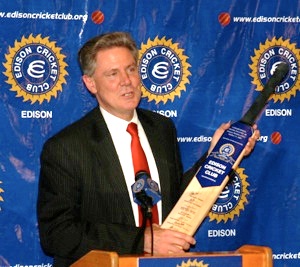
Before I go down that path, let me illustrate the importance of this with the story of a town nearer home called Edison. Now, Edison is known to have 'America’s liveliest Little India.' I am not saying this, The New York Times is. Edison schools have cricket grounds. The town has 400 Indian businesses and Indians make up roughly 25 percent of the population. The Oak Tree Road area wore a festive look during the 2011 World Cup. Not one, but two radio stations, air cricket talk shows into this town. TV Asia, the only broadcaster of domestic cricket, is based here. Edison is also the home of the Edison Cricket Club - a club which is visited by cricketing legends and dignitaries each year. Its members include U.S. Congressman Frank Pallone and N.J. Deputy Speaker Upendra Chivukula.
 I am certain Edison contributes a sum north of $1 million to the cricketing eco-system. The town easily accounts for a few thousand Willow or Neo subscribers, and per capita, residents play or watch more cricket than any other town in the country.
Pic (Right): U.S. Congressman Frank Pallone is a member of Edison Cricket Club. Membership of USACA is a different story.
Yes, Cricket is part of Edison’s DNA. But Edison, whose cricketing interest was the subject of articles in magazines ranging from SPAN to The Wall Street Journal, might as well be on another planet when it comes to USACA. The town has no involvement in cricketing matters – not at the regional level, not at the national level. Even its only club, the ECC, has no voice following CLNJ’s disqualification from USACA. USACA neither offers individual memberships nor grants voting privileges to clubs, so the town’s large base of cricket fans do not count at all.
In my estimate, just this one town could provide funds to sustain all of USACA’s annual development budget. Edison is not alone. In towns across the USA, there are hundreds of thousands of cricket fans and followers, hundreds of teams and clubs, and dozens of leagues which could contribute to the game’s growth. I am not suggesting at all that USA cricket be limited to immigrants. I am asking that USA cricket places reliance on their love and devotion for the game as a solid foundation on which to build cricket. Other sports have done it, why not cricket?
In order to do this, the national governing body must be willing to create a large community of players, administrators, fans and followers. Is ACF willing to go the extra mile and does its constitution permit that?
The answer is a resounding Yes!
Inclusive, not exclusive
Article 3 ("Membership") of ACF's constitution is an open embrace - "Membership in the Federation shall be open to: (a) Any youth player, adult player, coach, trainer, manager, administrator, official, fan or other individual active or interested in the sport of cricket. (b) Any affiliated sports organization or amateur sports organization."
This is similar to other world class sports organizations. Here is an excerpt from the bylaws for USA Baseball. “Any individual or sports organization active in baseball, or any individual or sports organization interested in the advancement of baseball in the United States and throughout the world.” USA Baseball specifically states that Board approval is not necessary for this class of members.
In comparison, membership in USACA constitution’s membership section is somewhat exclusive - "Membership in USACA is open to all organized cricket leagues, clubs, colleges and universities, with a verifiable membership base of at least fifteen members."
The result of this exclusivity is that USACA has fewer members. And when you have an organization that is accountable only to a dozen members, you don’t have to worry about discussion or debate.
Organizations that have fewer members can quell what little disagreement they encounter through patronage or handouts to a carefully selected few. On the other hand, openness brings with it transparency and broader participation makes for a more effective democracy.
Lower fees, greater incentives
 That brings us to membership fees and incentives. ACF has indicated that it would charge membership dues of $10 for individuals, $50 for clubs, $300 for softball leagues and $500 for hardball leagues. USA Rugby draws a portion of its revenue by charging between $5 and $65 for individual members and $150 per club, and I have always felt that USA Cricket needed to get off the high horse.
Pic (right): US Lacrosse offers a range of benefits, some of its own and some through its sponsors and partners
Some years ago, at USACA’s Dallas AGM, when USACA pondered individual membership for $25, I thought it was a stroke of genius and gave the proposal a lot of play in my coverage of the AGM. As with other USACA initiatives, that proposal went nowhere fast. For this reason alone, I must applaud ACF for reducing the gap between intent and execution.
ACF constitution not only treats individual members as a crowd-funding opportunity, it grants them votes and has already stated that it will provide them with member incentives. From what I have seen, ACF is also eager to embrace technology as a differentiator. ACF has already launched an online payment mechanism for membership. Also noteworthy is that, when the organization launched its draft constitution, it sought feedback by making an electronic feedback form available on its website besides encouraging feedback via Facebook.
I recommend that ACF also consider accepting donations, just as USA Rugby does, once it gets 501(c)3 status.
Introducing cricket to Americans
The most laudable guiding principles are in Article 2 of the ACF constitution titled "Purpose."
This section serves as a compass for the organization's long journey. Yes, ACF wants to be a national governing body and promote the sport and all that jazz. But among the 19 sections that comprise the organization's purpose, the one thing that jumps out is this line -
"Promote and support the introduction of the sport of cricket to individuals and communities who are not familiar with or traditionally associated with the sport of cricket in order to promote and enhance the overall diversity of individuals engaged in the sport of cricket."
Not enough has been done by the national governing body to spread cricket beyond its core base of first and second generation immigrants. That ACF has embedded this as its purpose and is willing to be measured on this goal is commendable.
The entire arc of a cricketer's lifespan
Equally impressive is the fact that ACF provides a membership option for everyone regardless of age or gender. As Stephen Rooke so perfectly put it at the Orlando meeting: “Our goal is to accommodate a wide array of American cricketing interests and the entire arc of a cricketer’s lifespan as it progresses from youth cricket to adult cricket to senior cricket.” Categorization in this manner allows the Federation to adjust incentives for different levels and, through the use of data mining, ACF could also make informed decisions when promoting the sport.
People with Disabilities
DreamCricket Academy once got a call from NJ's School for the Deaf to conduct a cricket camp for the kids there. What followed was simply magical but I digress.
ACF specifically mentions people with disabilities in its charter. “Cricket shall also include any variation of the sport that deviates from the rules set by the International Cricket Council in order to accommodate mental or physical disabilities as defined in the Americans with Disabilities Act.”
The point is that a world class national governing body must make a real effort to include people with disability. Consider USA Baseball for example, which goes a bit further: “To encourage and support baseball programs for individuals with disabilities and the participation of such individuals in baseball activity, including, where feasible, the expansion of opportunities for meaningful participation by individuals with disabilities in programs of baseball competition for able-bodied individuals.”
For its part, USACA makes no mention of players with disabilities.
Separation of Officers and Directors
Another area where ACF’s constitution must be commended is the line it draws between employees and elected representatives.
Let me quote from Article 1 of the US constitution: "no Person holding any Office under the United States, shall be a member of either house during his Continuance in Office." The founding fathers included this restriction to create legislative-executive checks and balances.
ACF envisages similar separation. Section 6.4 of ACF constitution says: “The CEO and all other employees owe to the Federation the duties of good faith and loyalty. Consistent with this, no person may serve simultaneously as an officer of the Federation and as a member of the Board or the Committee.”
ACF stipulates that the CFO, the Chief of Sporting Operations and the Secretary should be supervised by the CEO and contemplates that all officers who are responsible for day-to-day operations must be compensated in order to be effective and that they must be accountable to the board.
As we all know, USACA’s constitution specifically requires direct elections for the roles of Treasurer and Secretary. When you have just 15 vote-eligible leagues and several candidates in the mix, the winner is sometimes determined by political math. Also, popularity should not be confused with capability. USACA’s recent history is proof that popularity and capability do not always go hand in hand.
A vote for all
While continuing to provide a strong voice to the leagues (7 votes on the Board and 3 on the Advisory and Judicial Committee), ACF balances that by providing a direct voice to clubs and individuals (3 votes on the Board and 8 votes on the Advisory and Judicial Committee). Add to that the presence of an independent director, and ACF ends up with each constituency getting a voice while also ensuring that nobody has absolute power.
Combined with better member communications, this could also serve to energize individuals and clubs, especially those that want a more active role.
Zonal structure
One area where ACF’s constitution is surprisingly low on details is the zonal structure. At the ACF Face to Face meeting in Orlando, which I attended as CLNJ’s delegate, there was talk of creating an organization that respects zonal autonomy. League representatives also felt that the present USACA regional structure was imperfect.
Regardless, since the constitution mentions six zonal directors representing three zones, it is important for prospective members to understand the zonal composition and how they will be represented at the national level and within their zone. From a more practical standpoint, ACF will want to await the outcome of its membership drive before it announces the zones or it may end up with unequal zones in terms of size of membership. But not spelling out its current thinking regarding zones makes for poor optics, something it could potentially alleviate through a concept document or via the FAQs.

2020 May 09
USA Cricket faces the Covid-19 googly