Views
MLC 2026: Thanks For Coming, Corey Anderson
2026 Jun 22 by DreamCricket USA
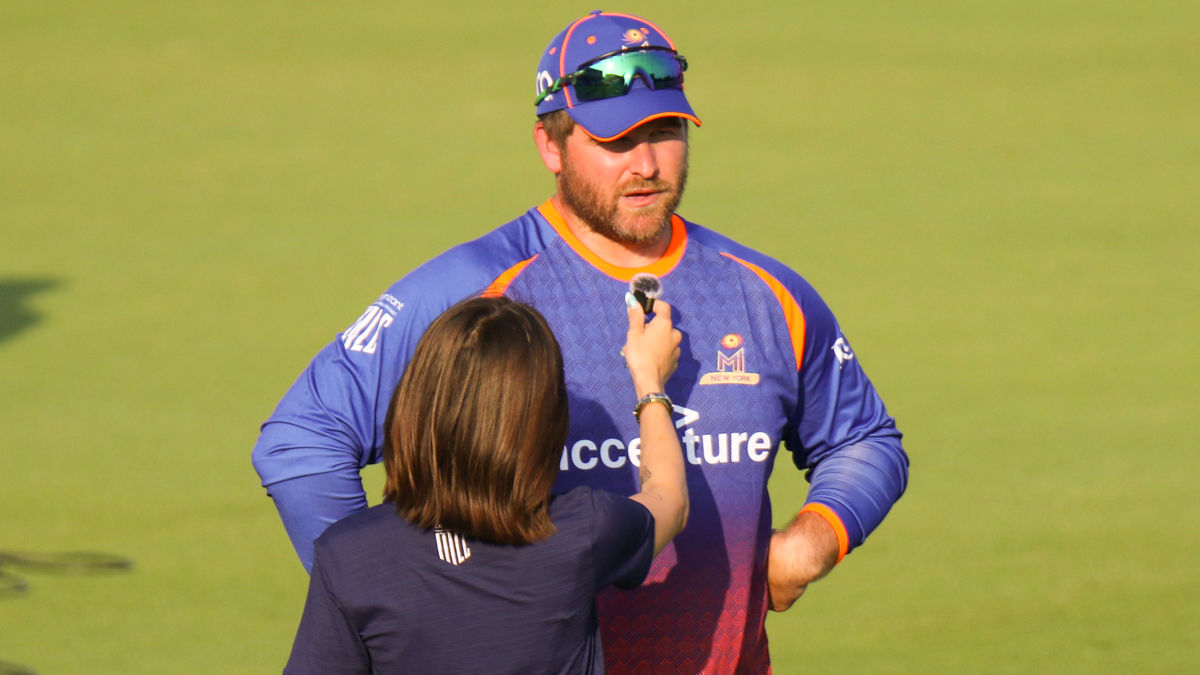
By Peter Della Penna (Twitter/X @PeterDellaPenna)The scorecard might not reflect it, but MI New York allrounder Corey Anderson's contributions can be seen and felt far and wide, on and off the field, whether it's on a personal level or across the American cricket community.
Photo credit: Peter Della Penna
Sunday, June 21 marked the start of a red-hot summer in Dallas, but Corey Anderson is now deep into the winter of his career. His passport may say he’s 35, but a laundry list of injuries and surgeries have worn him down over the years to the extent that as the man himself said, while sitting in a chair on the post-match press conference dais at Grand Prairie Stadium on Sunday night, “I probably feel like I’m about 45.”
Keep in mind Anderson is saying this on a night when he chalked up a pair of DNBs on the scorecard in MI New York’s eight-wicket win over Texas Super Kings. “Did not bat, did not bowl”. In cricket slang, that kind of non-existent statistical contribution in a given match also goes by another three-letter acronym. TFC: “Thanks for coming.” Plenty of club cricketers know the peculiarly hollow feeling of being a weekend warrior on a winning Sunday side in which you don’t actually get to do much of anything. It’s a much less common scenario for a former international player who at one stage was one of the world’s top allrounders, one who helped his country reach a World Cup final against Australia played in front of 93,013 people at the Melbourne Cricket Ground.
On that day in 2015, Corey Anderson was coming off a pivotal half-century in New Zealand’s epic last-ball semi-final triumph over South Africa in Auckland, which was staged in front of an equally raucous sell-out crowd of 41,279 at Eden Park. On Sunday, he entered MI New York’s contest on the back of a score of 11 in a loss to Washington Freedom played in front of a crowd that barely cracked 2,000. Rather than launch sixes into a sea of fans wearing the memorable orange bullseye target t-shirt for that Kiwi home summer’s “TUI Catch a Million” promotion, batters in Texas were targeting a sea of empty seats on the Texas Trust CU Theater side of Grand Prairie Stadium. Instead of having delays in play resulting from a euphoric one-handed catch celebration and the jackpot that came with it, any stalling at Grand Prairie was more often a consequence of waiting for a security guard to stir out of their seat and help find which section of grey concrete slab a white cricket ball may have blended into.
When you’ve reached the heights that Corey Anderson once did with New Zealand, including but not limited to a record-breaking 36-ball ODI century on New Year’s Day 2014 at Queenstown against the West Indies and a subsequent hefty payday via the IPL auction, the scenes that played out this past weekend at Grand Prairie Stadium can be a humbling experience. It can also lead to existential thoughts: What am I even doing here? Why am I still playing? Is any of this worth it?
From a literal standpoint, Anderson was compensated very handsomely throughout his New Zealand and IPL career, not to mention the other franchise T20 gigs he cashed in on during his prime. So it’s not as if he’s living paycheck to paycheck and is in desperate need of a few quick bucks from MI New York – who are paying him pennies on the dollar compared to what he used to make overseas – to put bread on the table.
From a figurative standpoint, Anderson has nothing left to prove on the field. There’s no shortage of YouTube clips highlighting his box-office exploits as a menacing middle-order power-hitter, golden-armed left-arm pace bowler and game-changing fielder, all of which have been preserved on the internet for posterity’s sake.
Yet Anderson continues to show up. It’s not for himself, in case his double DNB stat line left viewers in any doubt. But the humble Anderson is one who sees the forest for the trees.
“Look I think there’s still so much work to be done within the USA cricket landscape,” said Anderson. “Playing is obviously just a small part of that. But I feel like I get a really good connection with players, being understanding of what’s going on on the field.”
For those paying attention, Anderson often fields at mid-off for MI New York during the Powerplay overs. It means he’s usually the last one to flick the ball back to the bowler, and it gives him an opportunity in terms of situational proximity on the field to be able to have a quick chat to any bowler, especially the younger ones like a Rushil Ugarkar, and offer them bits of advice. Being able to bounce ideas off Anderson and pick his brain from all the experience he’s gleaned across close to two decades as a professional makes him an invaluable resource.
“If I can help some of the younger guys here in the States become better cricketers, then again I’ve still had the mindset from day one to now that whenever I leave this game and whatever it looks like, I just want it to be in a better place than what it was when I first came here,” Anderson said. “There’s still a lot of work to do in that department. That doesn’t mean I’m gonna keep playing for 20 years. But I think kind of having my fingers in a few pies with that kind of helps.”
It’s not just with a bat or a ball in his hand that Anderson has tried to be a positive force for change in American cricket. As noted earlier, Anderson has made his share of bucks in cricket. He could be content to sit back and count his money on an easy chair at home in suburban Dallas looking out for himself and not giving a thought to anyone else.
Instead, he was instrumental along with Dane Piedt in forming the first ever cricket players association in the USA (The US Cricketers' Association) aimed at helping players successfully negotiate better and fairer treatment from administrators. That can be anything from central contracts, match fees, tour stipends or other miscellaneous aspects of player compensation. When USA players were being low-balled with a pathetic pay deal on the eve of the 2024 ICC Men’s T20 World Cup by a miserly USA Cricket board mired in debt and legal battles, it was Anderson who was most vocal on behalf of his teammates to fight for a better compensation package.
Reading between the lines, his fearlessness in standing up to various USA Cricket board members and administrators coincided with him being dropped from the USA squad immediately after that year’s World Cup and he has yet to play for his adopted country since. Yet, he’s not been bitter about it, at least not publicly. Instead, he continues to take the high road when asked about a possible recall down the line.
“I’ve never made myself unavailable at any point,” Anderson said. “I think you probably don’t have to read too far to understand a little bit of the dynamics of USA Cricket here in this country. But look, I’ve always enjoyed this journey since I’ve been here in the States. It’s unique to a lot of us as well, coming over, uprooting your life and guys at different stages of their career trying to make a name for themselves. I probably had it slightly different in the sense that I had an international career [in New Zealand] and I was probably just trying to see where it went, create a bit of a legacy here in the States.
“So I’m still in that mindframe to be honest. I’m still enjoying it enough to go out on the field and run around and again playing with guys that I have ten years ago now, it’s nice to kind of get the MI kit back on, run out there and it’s always nice to look back and think of the memories that I created with MI and it’s always special to represent them again as well. So I’m excited for this season.”
Even his presence at the press conference itself is a microcosm of Anderson's persona vs. the franchise cricket ecosystem’s attitude toward dealing with the press. Unlike the American sports approach to post-game media availability, where the big four sports open up the entire locker room 15 minutes after a game ends to allow credentialed media their choice of who they want to speak to on any given day, cricket journalists are at the mercy of team officials on match days. Forget the entire squad in the locker room, the best case scenario is getting to speak to one player after a cricket match, or sometimes none at all if a team loses and any random member of the backroom staff is sent out instead to serve as a shield to block and deflect any critical questions.
However, even winning sides have gotten into the habit of regularly sending less than marquee performers out to deal with the written media, instead preserving the prized show-ponies for the TV broadcast presentation. Rather than looking forward to speaking to the media, it has created an attitude of drawing the short straw among many players.
If he didn’t want to be there, Anderson didn’t show it. Rather, he took his time to earnestly consider each question before giving layered answers. No robotic, regurgitated cliches.
By the end of the press conference, it became apparent that being at the stadium this weekend meant something significant to Anderson, a lot more than 11 runs off nine balls and 1 for 27 off two overs with the ball might indicate. When Anderson and Brendon McCullum were slaying bowling attacks for New Zealand like they were Gilgamesh and Enkidu storming the Cedar Forest to take down Humbaba, Anderson did so as one of New Zealand’s most eligible bachelors. Fast forward a decade and playing professional cricket on Father’s Day holds a different type of significance now that he’s married and settled in his wife’s hometown with two American-born kids. Suddenly, the monotony of American cricket and being a small fish in the giant pond of a FIFA World Cup summer pales in significance to being a dad soaking up your kids’ life milestones.
“There’s plenty of times where I wake up and go, ‘I don’t wanna play today,’ and I’m pretty sure there’s a lot of cricketers who probably feel like that as well,” Anderson said. “But I had my boy come and watch my first game the other day and so I think back to being part of the IPL in Mumbai colors and then getting to see my boy with a Mumbai jersey on, or an MI New York jersey on, running around the sideline with my wife and it kind of feels like a little bit of a full circle moment coming back to be like, there’s different reasons for why you start playing and why you continue to play. So that was pretty exciting to see my son on the sideline and at some point I’ll explain to him what I was doing out there.”
“It’s massive. I think when you are on the circuit, whether it be from an international team, domestic teams, franchise competitions, whatever it is, it can be a pretty lonely world in terms of just the turnover and you’re at a different team week to week, month to month. And I think it’s really hard for people to understand what some players actually go through. I’m really fortunate that my wife has supported me throughout kind of probably the last ten years of my career and she’s seen me go through the ups and downs and understand what it looks like and things like that. So it’s such a big part of my life that she understands what it actually looks like. It’s not just turning up at the end of it and going, ‘Oh, I didn’t know what cricket was.’
“So again, explaining to my boy, I mean he’s only four so it’s going to take him awhile as well but yeah having him being able to see dad do what he’s done and be able to look back and go, ‘Oh I went to a game, saw that,’ again it makes it pretty special to do a full circle of that. Especially on Father’s Day as well, just being here in the States, being in Dallas playing a home game, yeah it’s always pretty special. I love playing out here in Dallas and Dallas is my home and hopefully it will be for a long period of time.”
So, thanks for coming, Corey Anderson. From the media, who showed up to cover the tournament this weekend in Texas and who you generously offered your time, respect and peace of mind to. From the fans, who paid good money to be entertained by you, even if they only got to see one six off your bat instead of 14 like you did on that famous New Year’s Day a dozen years ago. From all of the up-and-coming cricketers in the USA, whether it’s the ones playing alongside you in the MI New York squad or the much younger ones who you coach on a regular basis at a local academy in Dallas, who gain wisdom from your insights, who get to observe in real-time what it means to be a professional not just in matches but through preparation and training habits, and who will be better compensated in the future because of your dogged efforts to stick up for them at the negotiating table. And from your American wife and kids, who are getting a chance to see their dad play for the first time because you still love playing cricket.