Views
USA Cricket: 2026 ICC Men’s T20 World Cup Tour Review Part 1: Team Grades
2026 Mar 19 by DreamCricket USA
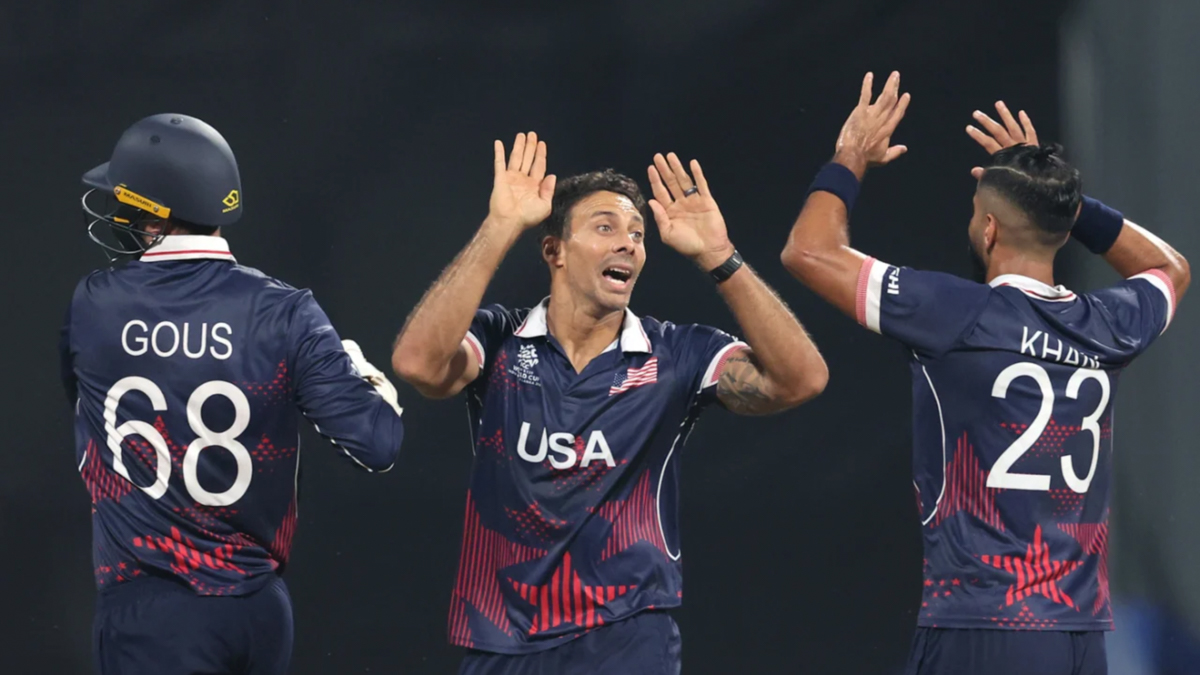
By Peter Della Penna (Twitter/X @PeterDellaPenna)Check out a rundown of USA's graded performances at the 2026 ICC Men's T20 World Cup across each of their combined batting, bowling, fielding and team management units.
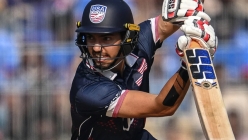
Photo credit: ICC via Getty
Batting: C-
Much of the team grades in this report card are weighted with a strong bias towards the performances in USA’s two matches against the Full Members in their group. USA posted scores of 200 against India A and 201 for 8 against eventual World Cup runner-up New Zealand in both of their warm-up matches. They also posted scores of 196 against the Netherlands and 199 against Namibia in both of their wins during the group stage.
All of those numbers make their struggle to end on 132 against India and 158 against Pakistan all that much more disappointing. In particular, their batting approach chasing a target of 162 on the opening night against India was extremely underwhelming. Granted that it came against the eventual tournament champions and their vaunted bowling attack. But USA’s batting failures in that match were much more down to approach than lack of skill or talent, and keep in mind they did not have to face up to Jasprit Bumrah in that match either. Rather than play fearless cricket, think of Italy or Nepal against England, USA’s approach for the first 15 overs was overwhelmingly timid.
Similarly against Pakistan when the required rate was 9.5 per over, the top order barring Shayan Jahangir was afraid to come out of their shell. Jayangir scored 49 (off 33 balls) of USA’s first 68 runs in the first 10 overs. At the other end, a combination of Andries Gous, Monank Patel and Milind Kumar scored a combination of 19 off 27 balls. At a time when they needed to be bold, USA’s batting stars were bland.
USA had two players cross 100 runs in the tournament (Shubham Ranjane and Sanjay Krishnamurthi), while four others had 90+ runs (Sai Mukkamalla, Monank Patel, Shayan Jahangir, Milind Kumar). It highlights USA’s okay but not great performances collectively. It also shows the general letdown of the top order in that USA’s two best scorers came from the middle order. By comparison, UAE, Scotland and Canada all had three players cross 100 runs. Two of the three players in each of those teams to do so did it from the No. 1-3 batting slots.
USA had six half-century partnerships in the tournament. Unsurprisingly, all six involved the six players mentioned above. Again, it highlighted the failures of others as much as the success of those named.
USA hit 33 sixes in the tournament. That placed them second behind only Italy and Afghanistan (both 34) among teams eliminated after group play. By comparison, Australia only hit 18 sixes. Again, it shows that USA did not lack talent or ability to perform, but they simply lacked confidence in big moments, especially when you compare it to Italy’s fearless approach. The fact that Italy had played 3 T20Is against a Full Member (Ireland) and beat them once in the month before the T20 World Cup whereas USA had not played against a Full Member since the end of the 2024 T20 World Cup may have played a factor in USA’s collective lack of confidence in these situations.
Considering the amount of talent that USA has at their disposal, their status as the top ranked Associate side in Cricket World Cup League Two and the amount of players they have playing in franchise leagues outside of the USA, their collective performance was underwhelming.
Bowling: B+
Considering that the tournament champions scored 250+ in both the semis and final against England and New Zealand (yes, albeit on different surfaces than the one they played USA on), USA’s bowling performance against India to hold them to 161 for 9 looks even more impressive than it did on the opening night of the tournament. Had the fielding supported them better (and that includes the bowlers themselves), USA might have pulled off one of the greatest upsets in cricket history. The team performance in that match is even more remarkable when considering the fact that USA’s all-time leading wicket-taker, Saurabh Netravalkar, had the worst performance of his career and the most expensive spell in T20 World Cup history.
USA’s bowlers were clinically efficient against Netherlands and Namibia, taking advantage of first innings scoreboard pressure provided by the batters to bowl out both teams without too much stress. The one minor letdown came against Pakistan when Sahibzada Farhan punished them badly in the Powerplay and put Pakistan in a position which USA could not claw back from.
By far the standout performer was Shadley van Schalkwyk, who took 13 wickets at an average of 7.76. Impressively, his haul of wickets was so strong that he stayed as the tournament’s leading wicket-taker all the way through the tournament final when India’s Jasprit Bumrah and Varun Chakravarthy finally overtook him. But his bowling average of 7.76 remained the best in the tournament for any bowler who bowled more than one over per team match.
USA’s spinners also performed very well, led by Harmeet Singh’s seven wickets at an average of 16.14, including a Player of the Match performance with 4 for 21 against Netherlands. Mohammad Mohsin’s overall figures might not have been eyepopping, but he was USA’s most consistent spinner and had a tremendous economy rate of 6.00 across 12 overs in which he took four wickets at an average of 18.00. Nosthush Kenjige, who played a key role for USA in 2024, was mostly stuck on the bench in this event but he still contributed well in his lone opportunity, taking 1 for 20 off three overs against Netherlands.
Ali Khan’s opening spell against India was full of adrenaline, not to mention skill. He took 1 for 13 off those two overs and had another chance dropped off his bowling. The biggest what if for USA may be what if Khan didn’t get injured in the field and was able to not only finish his spell in that match, but didn’t have to miss the game against Pakistan. He came back for the final two matches against Netherlands and Namibia and clearly was not 100% fit.
The most shocking performance in the bowling unit came from Saurabh Netravalkar. USA’s all-time leading wicket-taker and the cult hero of the 2024 T20 World Cup gave up the most expensive figures in T20 World Cup history against India, was dropped two matches later and ended with two wickets at an average of 66.00. Ehsan Adil, who came in for a debut against Pakistan in place of Ali Khan, was very underwhelming. Milind Kumar, who was expected to play a key role bowling to left-handers with his part-time offspin, was equally ineffective and finished with no wickets.
Perhaps the most amazing thing about USA’s bowling output is that the stars were not the usual suspects. It highlights that USA has reasonable depth. If the more established names had put in similar performances, USA very well may have made it back to the Super Eights.
Fielding: C+
USA’s overall fielding was actually very good. The main issue is that they had some extremely costly drops in key moments, none more so than on the biggest stage against India on opening night that dramatically changed the fate of USA’s Super Eight hopes.
None was more costly than the Shubham Ranjane drop off his own bowling with India captain Suryakumar Yadav on just 15 with the score at 63 for 4 in 10 overs. Yadav went on to make 84 not out, meaning he scored 69 out of India’s final 98 runs across the last ten overs. Had his catch been held, who knows what would have unfolded afterward.
That was not the only chance Ranjane missed and USA had a few other weak links in the field, but their standards have improved markedly even since the previous T20 World Cup, especially with the addition of Sanjay Krishnamurthi and Milind Kumar as regulars in the USA XI since the previous T20 World Cup.
Tactics: D
This is not just during the tournament but in their team selection leading into the event. Team management’s stubborn refusal to remove Jessy Singh not only from the vice-captaincy but from the squad itself was unintentionally rectified when he was injured in the warm-up against New Zealand 48 hours before the first match. If Singh is healthy, Van Schalkwyk doesn’t play at all. It highlights the poor decision-making from team leadership in several areas.
Having harshly left out Rushil Ugarkar from the final 15-man squad, USA management had a chance to correct the mistake when Singh needed to be replaced following his injury. Instead of a forward-thinking, not to mention merit-warranted, decision to bring in Ugarkar, team management went the hackneyed route with Ehsan Adil. It is yet another example of the historical trend for USA selectors and management to default to pick players with first-class experience in overseas systems rather than put faith in homegrown talent with less exposure to professional systems when there is a 50/50 coin flip decision between the two options. This would have been more understandable in the pre-Major League Cricket era. But Ugarkar proved himself on a big stage in the MLC final during his last-over showdown against Glenn Maxwell, and has consistently demonstrated since then that his performance that night last July was no fluke. And yet he was snubbed anyway. Adil then followed with a forgettable debut for USA.
Within matches themselves, the tactics were also conservative rather than daring. This was most evident against India and Pakistan when Milind Kumar was sent in at No. 4 during sequences of the match when the required run rate was already slipping well out of hand. Rather than sending in a microwave power-hitter like Sanjay Krishnamurthi or Shubham Ranjane, USA went with a slow-starter in Kumar both times. It only exacerbated the required run rate equation in both matches.
The decision to drop Sai Mukkamalla after the loss to India for the match against Pakistan was also extremely disappointing on a number of levels. Mukkamalla has been far and away USA’s leading scorer in T20Is since making his debut after the 2024 T20 World Cup. He’s also done it at a strike rate of 150. Yet he was left out against Pakistan for what team management later described as a decision for “team balance”. Shayan Jahangir performed very well as Mukkamalla’s top order replacement against Pakistan. The issue wasn’t Jahangir coming in. It was Mukkamalla being left out. Someone else should have paid the price if there was to be a scapegoat for the batting failure v India. If they were trying to send Mukkamalla a wakeup call, then the message was received because he came back in against the Netherlands and top-scored with 79.
Kumar’s continued presence in the XI was also perplexing. Ostensibly he was being picked not only as a batter, but also someone to bowl offspin to left-handers in the mold of Steven Taylor’s longtime role in the USA squad. However, he only bowled four overs, conceding 0 for 43. Kumar’s fielding was valuable, but his batting offered little and made his continued selection harder to justify. The most obvious replacement for Kumar in the XI in terms of a like for like player within the squad would have been Shehan Jayasuriya as a batter who can bowl offspin. But the reluctance to pull the trigger on that switch also sparks questions as to why Jayasuriya was given a place in the squad ahead of other options in the pipeline, especially when he was not even deemed good enough to be a part of any MLC franchise in 2025.
With several tweaks, USA might have had a better chance to beat either India or Pakistan. But their selection tactics before taking the field were uninspiring, and similar can be said for the decision-making once the players took the field.
Fitness: B
USA’s overall fitness standards have grown leaps and bounds since gaining ODI status in 2019 and with it the freedom to commit full-time to cricket thanks to central contracts. The setback in terms of fitness on this tour came with a stomach virus that meandered through the squad, making several players unavailable at different points of the tournament.
However, there were also other issues. Ali Khan’s career has been riddled with injuries and another one was sustained during this event that held him out of the Pakistan match. Ranjane’s injury in the same match against India affected team balance going forward because he continued to be picked as a specialist batter but his inability to bowl a full spell forced USA into dropping Mukkamalla to add another bowler as cover.
On the flip side, seeing a 37-year-old like Van Schalkwyk be the team’s star performer shows that there are zero excuses for any younger players coming through the pipeline to not be taking their fitness seriously.
[Views expressed in this article are those of the author, and do not necessarily represent the views of DreamCricket management. If you have different views, we respect those views and urge you to provide your feedback, both positive and negative. Feel free to respond to the author via Twitter/X @PeterDellaPenna.]
Recent Views